Mellon voices
What’s the Point of Higher Education in Prison? For One Thing, It’s a Human Right.
Making a podcast in a Florida prison might seem, to anyone but Brunson, all but impossible. The Central Florida Reception Center or CFRC, doesn’t allow any electronics—no microphones or recorders, no laptops, not even a cell phone. So the incarcerated students have to handwrite their stories and, in an exercise of trust, turn them over to University of Central Florida (UCF) journalism students to produce, voice, and publish.
“This class is an opportunity for these men and women to regain some sense of their own humanity,” Brunson said. “They’re paying a penalty for what they've done wrong to society. But that doesn't mean that anybody should be robbed of their dignity or of their humanity, and education is the opportunity and one way for incarcerated students to retain or regain some of that dignity and humanity.”
The podcast is called The Unheard Society, a name the inaugural group of incarcerated students came up with in 2023. It’s a collaboration between traditional students at the UCF Nicholson School of Communication and Media and incarcerated students participating in the Florida Prison Education Project—a volunteer-run program founded in 2017 at UCF to bring higher education to central Florida prisons.
Brunson is co-founder of the series with fellow UCF member Dr. Erica Rodríguez Kight.
“It’s an inside, outside job,” as Brunson puts it. The first part of the class takes place inside the prison with incarcerated students, the second, outside at the UCF campus with traditional students. Brunson teaches the class in prison with the help of a UCF student teaching assistant, like Keenan, who then acts as executive producer for the students on the outside as they produce the episodes. It’s a logistically complicated partnership, but it works.
Keenan first learned about The Unheard Society when she worked on an episode called “The Flower Hour with Tyshawn Thomas” in her junior year electronic journalism class. It tells the story of a young, gay, Black, and Native man’s journey from rural North Carolina to a Florida prison. His story explores how that identity impacts him in prison—other incarcerated people call him a “flower”—and details how he has suffered harassment and violence because of it.
She was so moved by the work she asked Brunson to be his next teaching assistant.

Raine Keenan
Student producer and teaching assistant, The Unheard Society
“I wanted to be a part of it so badly, to report on things that are unique and something that is sort of hidden away from the public eye, that people are uncomfortable talking about.”
“I wanted to be a part of it so badly,” Keenan said, “to report on things that are unique and something that is sort of hidden away from the public eye, that people are uncomfortable talking about.”
There are a lot of stories to tell in Florida prisons. The state houses more than 80,000 people incarcerated in its 134 correctional facilities and has among the most restrictive access to higher education of all prison systems in the United States. Despite evidence from the Mackinac Center for Public Policy that access to education reduces recidivism by nearly 15 percent, as of early 2024 less than one percent of the 80,000 incarcerated people in Florida qualify to take higher educational classes for credit. It’s a complex issue involving state and government funding, Pell Grants, and restrictive Florida laws. So FPEP is working to make a tiny dent in that number. FPEP students can’t receive credit while they’re incarcerated but can petition for credit upon release.
From the start, the challenge was clear. How do you teach electronic journalism in a prison where you can’t bring any recording equipment? Not only are all electronics banned, but CFRC incarcerated students also have limited access to technology or even the Internet. Some had never even listened to a podcast.
“We had to get creative,” Brunson said. “So we focused on the writing.”
Now the eight-week class, ranging from 3 to 12 students each semester, meets for 90 minutes, once a week. Several lessons mirror the traditional class, with reading assignments and discussion groups, all leading to the final project—a personal narrative podcast script. The incarcerated students handwrite their stories with pencil and paper, each draft carefully revised in their composition notebooks.
After a while, it’s impressive how much the system works, said UCF senior Alex Gormley, who taught with Brunson this past spring at the Orlando Community Release Center, a minimum-security women’s prison. That semester's classroom was a cramped, noisy prison cafeteria.
“They come in, and they do the quizzes, and we talk about the book, and we talk about what they read, and they write, and we discuss,” he said. “Even though the environment is so different, the actual class just kind of felt like a class.”
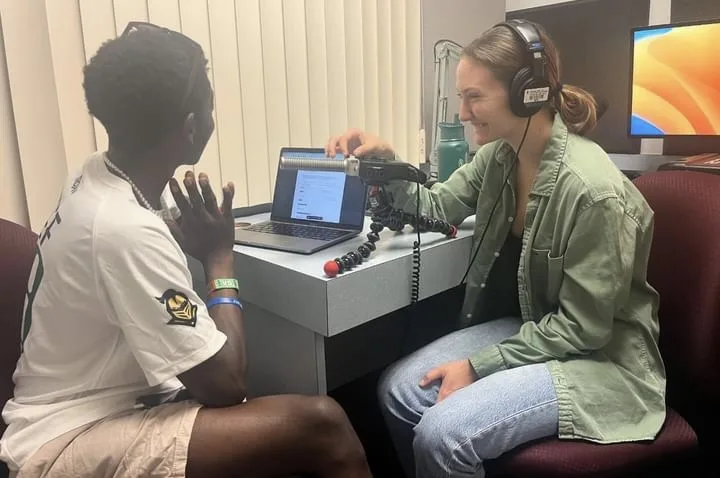
The incarcerated students can choose the stories they want to tell. Some talk about life in prison, about working in the cafeteria, or surviving the indignities of incarceration through humor. Some talk about how they ended up in prison, others about their fears for post-release. There’s one rule though. Unless they themselves bring it up, Brunson never asks what any of his students did that led to them being incarcerated. For those 90 minutes, once a week, it’s his job to make them feel like more than just incarcerated.
“That classroom, that space, is one of the few places where they feel like they can be fully human and have dignity and not be defined only as what they did,” Brunson said.

After a few rounds of revisions from their teachers, the incarcerated learners turn in a final handwritten script, along with a handwritten and numbered sound list that corresponds with moments in the script where incarcerated students want the audio to appear—things like cafeteria noises, a toilet flush, or people fighting.
Those scripts are then assigned to small teams of UCF journalism students. The incarcerated students can't voice their own work, so the students work diligently to find and cast volunteer voice actors who mirror the demographics and vocal intonation of the writer, doing their best to accurately represent the person whose story they're telling. They take authenticity seriously.
“At the end of the day, [the incarcerated students are] laying down their worst experiences in front of you,” Keenan said, “So there's something about somebody who is being so vulnerable, especially in the position that they're in right now, and instead of letting it rot into something that's shameful or guilty, they're turning it into something that other people can digest.”
Brunson says the UCF students feel a weight of responsibility largely because they know the incarcerated students won’t have an opportunity to provide feedback. Most of the prisoner podcasters never get to hear the final work. Between limited technology access and the timing of when the episodes are completed, playing the finished podcasts for the writers is difficult. Since the program started in 2023, only two of the four classes have been able to listen to their stories.
For the inaugural class, Brunson was able to burn the episodes onto a CD and play it on a shared, public computer. That day, the men sat around the tiny speakers listening intently.
“Some of the guys were just moved to tears hearing their words come out through the speakers,” Brunson said. “It was very moving to them and moving to all of us.”

Richard Brunson
Co-Founder, The Unheard Society
“Education is the opportunity and one way for incarcerated students to retain or regain some of that dignity and humanity.”
The efforts of the students, both incarcerated and civilian, have been recognized. The Unheard Society has won several regional and national awards, including two Florida Association of Broadcast Journalists College Radio Awards and a Broadcast Education Association's BEA Festival of Media Arts Award of Excellence.
“It’s huge because the students on the inside, their names are on the award, and the students on the outside, their names are on the award,” Brunson said.
Just like the podcast episodes themselves, it’s hard for prisoners behind the project to see or interact with any of these accolades. Yet, in an end-of-year semester review, one incarcerated podcast student said something that Brunson has never forgotten. When he was in class, he wrote, he had felt like he was not in prison.
“That’s everything to me,” Brunson said. “That’s everything. They’re free in their minds and in their spirits for 90 minutes to explore what their lives mean and the meaning they’re trying to make out of it. It’s a beautiful thing.”
The Unheard Society is a project of the Florida Coalition for Higher Education in Prison at the University of Central Florida, and received a grant of $750,000 through Mellon’s Higher Learning program in 2024.