Mellon Mays Undergraduate Fellowship
MMUF Eligibility Requirements
MMUF began with eight participating institutions: Bryn Mawr College, Carleton College, Cornell University, Hunter College, Oberlin College, Swarthmore College, the University of Chicago, and the University of Pennsylvania. The following year, eleven more schools joined the program, including the UNCF consortium of historically black colleges and universities. By 2001, the number of member institutions had nearly doubled and broadened to include higher learning institutions in South Africa.
William G. Bowen
Co-founder of MMUF and Foundation president (1988–2006)
“MMUF is a network. And I think that over time, the reverberating effects of this network are going to be very, very substantial. ”
In 2003, the Foundation reaffirmed its commitment to and broadened the mission of MMUF. The name of the program was changed to the Mellon Mays Undergraduate Fellowship Program in honor of the stellar educational achievements of Dr. Benjamin E. Mays.
Benjamin Elijah Mays was born in 1895 in Ninety-Six, a small town in South Carolina, to parents who had been born into slavery and freed at the end of the Civil War. Mays excelled as a student from an early age, and was driven throughout his youth by what he termed “an insatiable desire to get an education.”
Beginning in a one-room rural schoolhouse, he graduated from the high school at Orangeburg’s State College and entered college at Virginia Union in Richmond, Virginia. Determined to continue his education outside the segregated South, Mays entered Bates College in Lewiston, Maine. Despite being one of very few Black students at Bates, Mays felt that his teachers and peers treated him as an equal. He wrote of his years at Bates, “For the first time . . . I felt at home in the universe.”
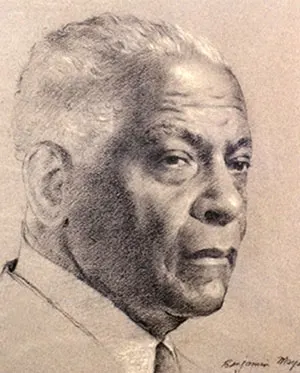
Mays set his sights on the University of Chicago for graduate study, and entered the Divinity School there in 1921. He interrupted his graduate studies to accept teaching jobs at institutions including Morehouse College, as well as positions with the National Urban League and the YMCA. He always returned to his chosen course, earning his master’s degree in 1925 and his doctorate in 1935. During these years, he was also ordained into the Baptist ministry. From 1934 to 1940, Mays served as dean of the Howard University School of Religion and then became president of Morehouse College, a position he held with distinction for the next quarter of a century.
Mays spoke early and often against segregation and for education. He was a model for one of his Morehouse students, Martin Luther King Jr., and he served as an unofficial senior advisor to the young minister. Mays gave the closing benediction at the 1963 March on Washington, as well as the eulogy at King’s funeral.
Among his many books were the first sociological study of African-American religion, The Negro's Church, published in 1933, and his autobiography Born to Rebel. His writings reveal a combination of sharp intellect, religious commitment, and prophetic conviction. Mays received nearly thirty honorary doctorates and other honors, including election to the Schomburg Honor Roll of Race Relations. He died in 1984 and is buried on the grounds of the Morehouse campus.